

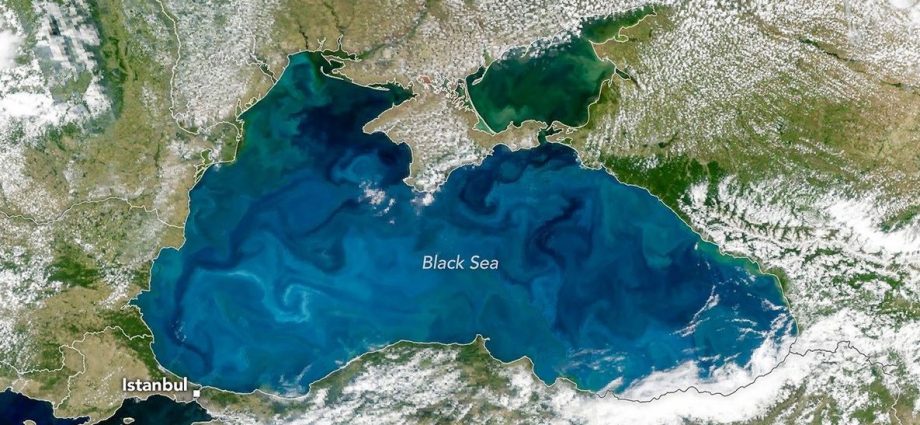
The Black Sea was dressed in turquoise
The Black Sea sits at the boundary between Europe and Asia and connects to the Mediterranean Sea via a chain of waterways. Its surface often appears dark, but each spring and summer it transforms into a striking expanse of swirling turquoise. The OCI (Ocean Colour Instrument) on NASA’s PACE (Plankton, Aerosol, Cloud, ocean Ecosystem) satellite captured this image (above) of the colourful waters on 22 June 2026.
The turquoise colour is likely caused by coccolithophores,
a type of phytoplankton covered with calcium carbonate plates that can give surface waters a milky-blue appearance. These types of phytoplankton tend to dominate in late spring and early summer. Other times of the year, diatoms—a type of microscopic algae with silica shells—can become more prevalent, and they tend to darken the water rather than brighten it.
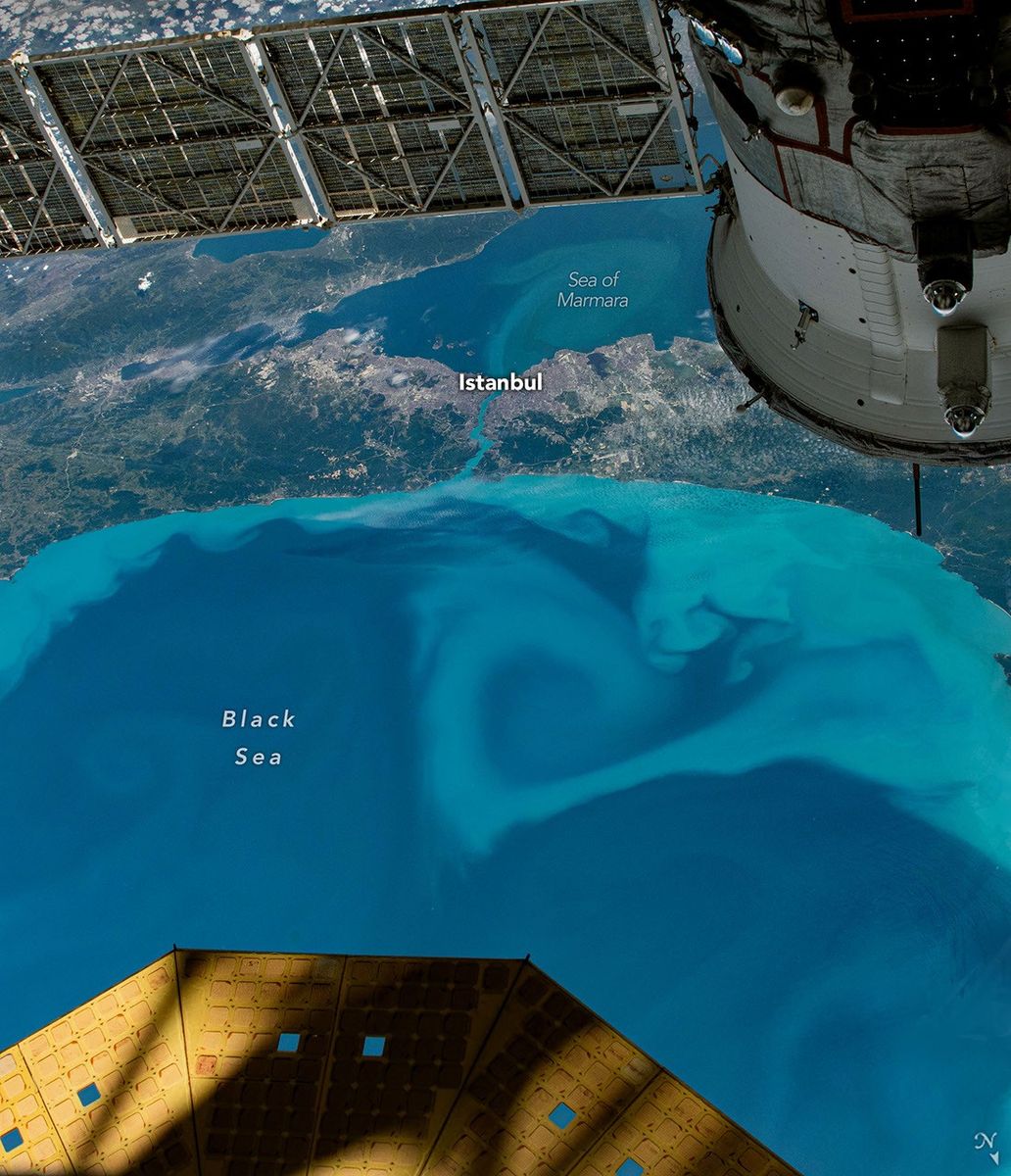
The Bosphorus, the narrow strait running through Istanbul that connects the Black Sea with the Sea of Marmara, also turned turquoise. An astronaut aboard the International Space Station photographed the strait on 27 May, 2026, about a month before the PACE image, capturing blooming phytoplankton as it traced currents on both sides of the waterway. (Note that north is oriented toward the bottom of the frame.)
Though coccolithophores are microscopic, they become so abundant during a bloom that they become visible from space. This makes remote sensing a useful tool for researchers studying bloom dynamics in regions where direct sampling is limited. Beyond their visibility, these blooms also contribute to the ocean’s carbon cycle. When they die, some of the carbon they’ve taken up sinks to the seafloor, where it can remain stored for long periods of time.
Thank you for sharing this article! For comments, please scroll down below the related articles! | SUBSCRIBE TO OUR FREE NEWSLETTER HERE ✉️ | Source: NASA | Cover image: NASA Earth Observatory image by Michala Garrison, using PACE data from NASA EOSDIS LANCE and GIBS/Worldview and the NASA Ocean Biology Distributed Active Archive Center OB.DAAC.

Dear reader,
join the Club HERE to access all exclusive supporter-only content! You can also make a one-time donation via PayPal (just click the small button!). [paypal-donation]
If you would like to support CenWeb and the reserve in another way, please email us at centauri16@gmail.com. We greatly appreciate your support!
Explore more on CenWeb